Client
SYCTOM
CALENDAR
2024 – 2026
LOCALISATION
Ivry-sur-Seine, France
Context
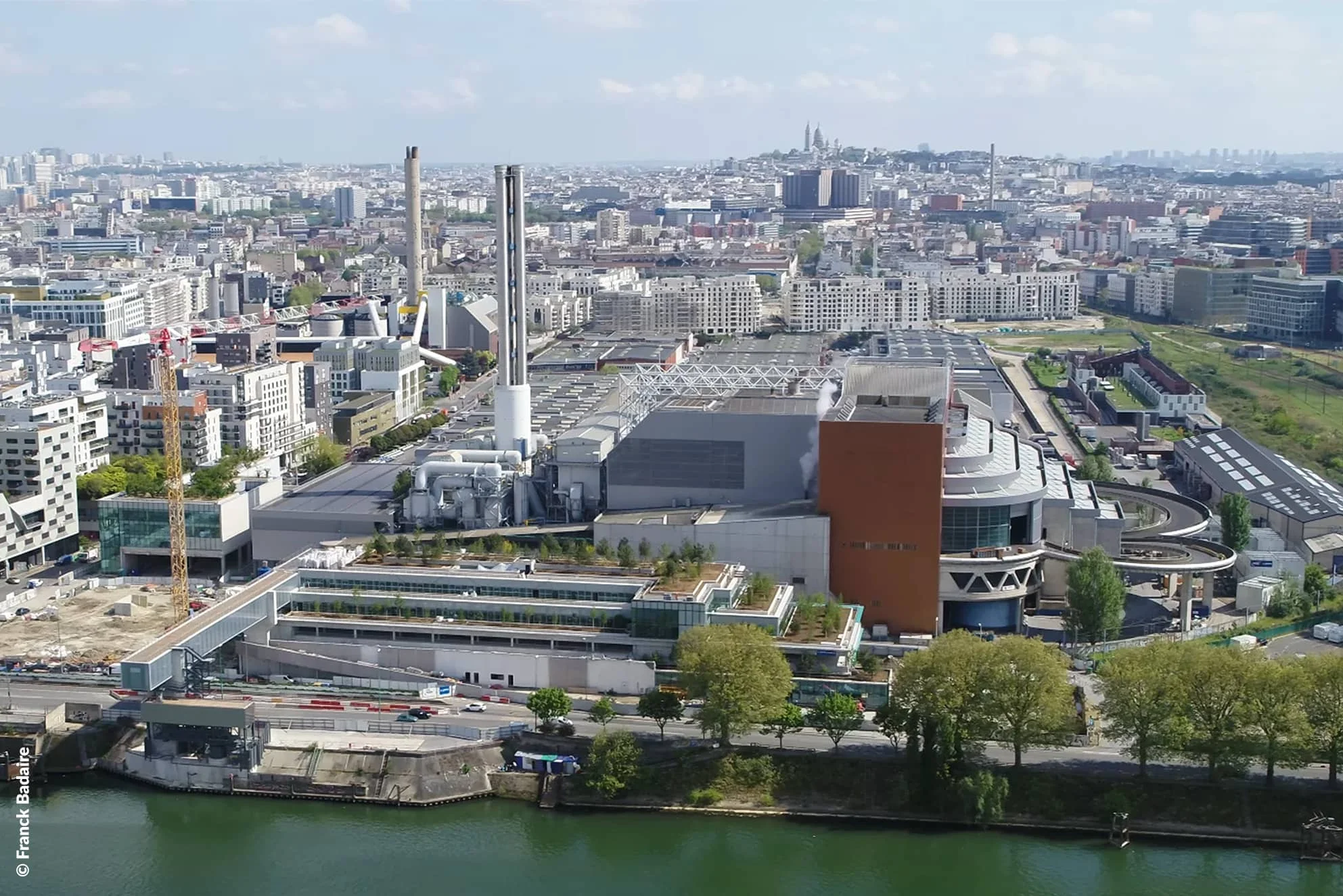
The SYCTOM, a public service for the treatment and valorization of household waste from 82 communes in Île-de-France, is seeking to reduce the carbon footprint of the Ivry-sur-Seine UVE by developing innovative decarbonization solutions.
In collaboration with the BRGM, SYCTOM is deploying the «CO₂-Dissolved» technology, which combines the capture and storage of industrial CO₂ in aquifers with the production of geothermal energy, thus reducing CO₂ emissions by approximately 100,000 tonnes per year.
Our mission is to assess the technical and economic feasibility of CO₂ capture solutions from the fumes emitted by this waste incineration plant through technologies that present limited environmental impacts and risks and are compatible with a dense urban fabric.
DETAILED MISSIONS
SYCTOM entrusted us with the following tasks:
- Benchmark for CO₂ capture solutions;
- Definition of the criteria for acceptability to evaluate the technologies identified;
- Study of the feasibility of the chosen solution from a technical, economic and environmental perspective;
- Analysis of the entire treatment chain: pre-treatment of fumes, capture, regeneration of solvent, treatment of effluents, CO₂ conditioning compatible with the expected geothermal injection (P, T, state);
- Optimizing the energy performance of the system, limiting the use of steam;
- Installation of all the technological bricks;
- Evaluation of the CAPEX/OPEX of the installation;
- Interconnections and operations compatible with that of the existing site;
- Overall environmental assessment of the project.